Invisalign® in Denton and Krum, TX
See your finished smile before you begin.
If you’ve gotten good at smiling with your lips closed, Invisalign can change that without anyone noticing you’re in treatment. At Cramer Orthodontics in Denton and Krum, TX, Dr. Chris Cramer spent 13 years as a mechanical engineer before becoming a board-certified orthodontist, and he maps your tooth movement in 3D before your first tray goes in.
If you’ve been working around the same few teeth for years, you already know what they cost you: the photo you angle away from the camera, the gap you check in the mirror before a meeting. The cost can go past confidence. Crooked teeth are harder to clean, which is linked with a higher risk of decay and gum disease, and teeth also shift naturally with age. Invisalign suits mild to moderate cases best, so starting while your case is still on the milder side can keep your options open.
Will Anyone Notice I'm Wearing Invisalign?
Few people will. Your trays are smooth, clear plastic made from SmartTrack, with no brackets or wires to give them away. They come out whenever you eat, so there are no food rules to memorize, and there is no complicated cleaning routine to learn. Check-ins with Dr. Cramer come about every six weeks, which leaves room for a work or class schedule.
How Does Invisalign Work, and How Long Will It Take?
You wear a series of custom clear trays and move to a new set every one to two weeks. Most treatment takes 12 to 18 months, and some simpler cases finish in about six.
- A free consultation. Dr. Cramer reviews your goals, examines your teeth and bite, and tells you whether Invisalign fits. Our team may take photos and a digital scan or X-ray first, as described on our first visit page.
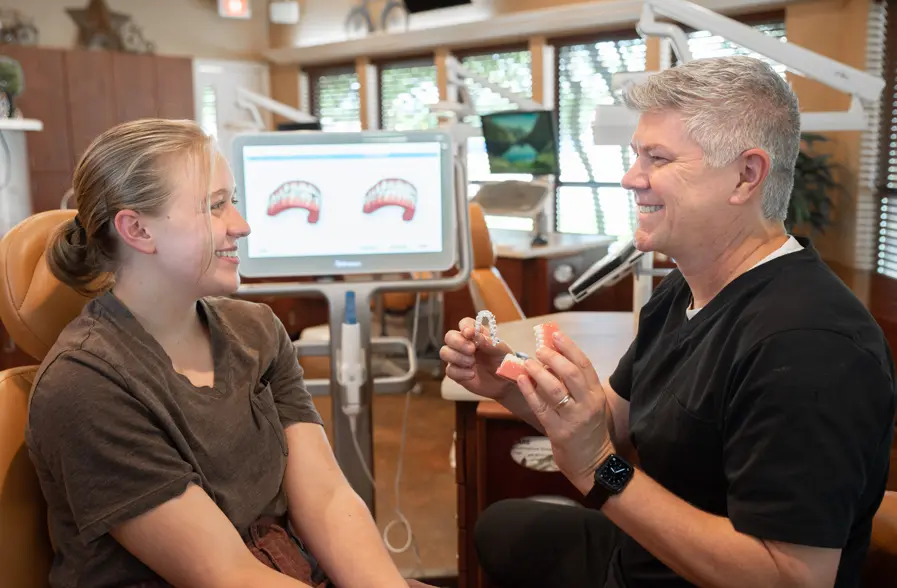
- Your 3D plan and preview. Dr. Cramer maps each tooth’s movement from start to finish, and you see a preview of your future smile before treatment begins.
- Your trays. You wear each set 20 to 22 hours a day, taking them out only to eat and to care for your teeth.
- Check-ins. About every six weeks, Dr. Cramer checks that your teeth are moving as planned.
- Keeping your results. After active treatment, a retention plan holds your new smile in place.
When your last set is done, you’re the person who smiles with teeth in the group photo and doesn’t think about it.
Is Invisalign Enough for My Bite, or Will I Need Braces?
Invisalign is a strong fit for mild to moderate cases: gaps, crowding, overbites, underbites, and mild relapse after earlier orthodontic treatment. How closely you follow the wear schedule affects how quickly and how well it works. If your case is more involved, Dr. Cramer tells you at your consultation, and ceramic braces with tooth-colored brackets are another subtle option the office offers. If you’re an adult wondering whether you’ve waited too long, our adult orthodontics page covers that.
Who Will Plan My Invisalign Treatment?
Dr. Chris Cramer, DDS, MS, MBA, is a board-certified orthodontist and a certified Invisalign provider. He spent 13 years as a mechanical engineer before becoming an orthodontist, so the 3D plan behind your trays comes from someone who spent a career thinking about how things move and fit. His Certificate in Orthodontics from Texas A&M / Baylor College of Dentistry means the exam at your consultation comes from a specialist who can tell you plainly whether clear trays will move your teeth the way you hope. He also received the Harry Sicher Research Award for research on safely speeding tooth movement.

What Does Invisalign Cost, and How Do I Pay for It?
Your fee depends on how complex your case is, and Dr. Cramer quotes it after your evaluation. An initial payment is due when records are taken, and the rest is spread across your treatment. We are not tied to any insurance network and, in most cases, file claims for you. Orthodontic benefits are usually separate from general dental coverage and carry their own lifetime maximum, so we review your plan before you start and explain what you’re likely to pay out of pocket. Our financial options page walks through the details.

Know Where Your Teeth Are Headed Before You Commit
You’ve been working around those teeth for a long time. At your free consultation, Dr. Cramer examines your teeth and bite, reviews your scans, and tells you plainly whether Invisalign will get you where you want to go, so you know before you commit to anything. Call 940-382-8122 and our team will set up your visit and answer your questions before you arrive.
What People Ask Before Starting Invisalign
Not really. Some pressure or mild soreness is normal when you switch to a new set of trays, and over-the-counter pain relievers usually manage it. Everyone’s teeth respond a little differently, and Dr. Cramer can tell you what to expect for your own treatment at your free consultation.
Most Invisalign treatment takes 12 to 18 months, and some simpler cases finish in about six. Your timeline depends on how much your teeth need to move and how closely you follow your wear schedule. Dr. Cramer gives you an estimate for your own teeth at your free consultation.
Plan on 20 to 22 hours a day. You take the trays out to eat and to care for your teeth, and the rest of the time they stay in. How consistently you wear them is one of the biggest factors in how quickly and how well your teeth move.
You typically see Dr. Cramer about every six weeks, and you move to a new set of trays every one to two weeks at home. Each check-in is a chance to confirm your teeth are moving as planned and to ask anything that has come up since your last visit.
Yes, for mild to moderate cases. Invisalign can address gaps, crowding, overbites, underbites, and mild relapse after earlier orthodontic treatment. More involved cases may be better served by braces, and Dr. Cramer tells you which route fits your teeth when he examines them at your consultation.
Adults can get Invisalign. Your age and how consistently you wear your trays both play a role in how quickly your teeth move, and Dr. Cramer explains what to expect for your teeth at your consultation. Our adult orthodontics page covers how treatment is planned around work and daily life.
Your fee depends on how complex your case is, not on how many visits you make, and Dr. Cramer quotes it after your evaluation. An initial payment is due when records are taken, and the balance is spread across your treatment. Unexpected costs, such as a replacement retainer, are quoted up front.
It may. Orthodontic benefits are usually separate from general dental coverage and have their own lifetime maximum. Cramer Orthodontics is not tied to any carrier’s network, accepts assignment of benefits in most cases, and reviews your plan before treatment so you know what to expect out of pocket.
Yes, at both offices: 1617 E. McCart St., Suite 200 in Krum, and 1308 Crescent Street, Suite 108 in Denton. Call 940-382-8122 to choose the one that’s closer to you. At the visit, Dr. Cramer reviews your goals, examines your teeth, and tells you whether Invisalign is the right fit.
 5-Star Rated by 310+ Patients